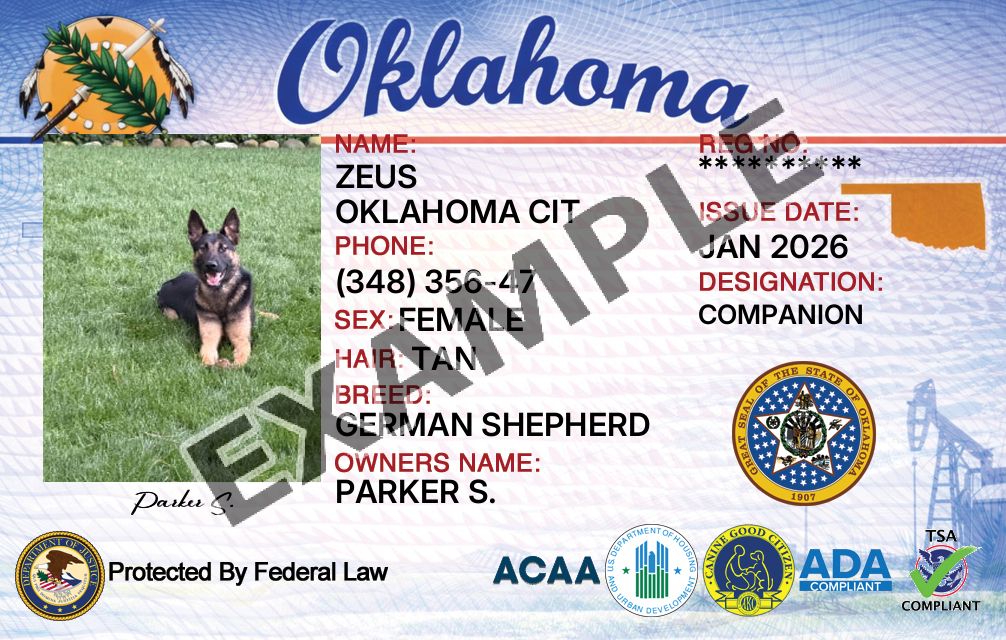
If you’re asking where do I register my dog in Grant County, Oklahoma for my service dog or emotional support dog, the most important thing to know is this: dog registration (licensing) and disability-related animal status are separate issues.
In practice, a dog license in Grant County, Oklahoma (sometimes called “animal registration”) is typically handled by a local city office (for example, Medford City Hall) and may also involve county-level enforcement or guidance tied to public safety and rabies control. Service dog access rights come from disability laws—not from a local license. Emotional support animals (ESAs) are also not “registered” with a county for public access.
Where to Register or License Your Dog in Grant County, Oklahoma
Because licensing is often handled locally, the right place to start depends on whether you live inside a city’s limits (such as Medford) or in an unincorporated area of Grant County. Below are several example official offices that residents commonly contact for where to register a dog in Grant County, Oklahoma, animal registration, rabies-related guidance, or animal control enforcement.
City of Medford (City Hall) — Animal Registration
| Phone | (580) 395-2823 |
|---|---|
| city@medfordoklahoma.org | |
| Street Address | Not listed in the official animal registration notice provided. |
| Hours | Not listed in the official animal registration notice provided. |
| Notes | Annual animal registration is referenced by the City; contact City Hall for steps and requirements. |
Grant County Sheriff’s Office (Animal Control / Enforcement Help)
| Street Address | 219 N. First St. |
|---|---|
| City/State/ZIP | Medford, OK 73759 |
| Phone | (580) 395-2356 |
| admin@grantcountysheriff.org | |
| Office Hours | Administrative Office Hours: 8:00 a.m.–4:00 p.m., Mon–Fri |
The Sheriff’s Office is a practical contact for guidance on local enforcement questions, roaming dogs, bites, or who handles animal control in your specific location.
Grant County Health Department (Rabies / Public Health Guidance)
| Street Address | 103 South 2nd Street |
|---|---|
| City/State/ZIP | Medford, OK 73759 |
| Phone | (580) 395-2906 |
| Not listed on the county page provided. | |
| Office Hours | Mon–Fri 8:00 a.m.–5:00 p.m. (Closed 12:00 p.m.–1:00 p.m.) |
Helpful for rabies prevention information and what to do after animal bites/exposures. Dog licensing decisions are usually local, but rabies enforcement is often tied to public health rules.
Grant County Clerk (General County Office Directory Starting Point)
| Street Address | 112 E Guthrie, Room 102 |
|---|---|
| City/State/ZIP | Medford, OK 73759 |
| Phone | (580) 395-2274 |
| rmccaleb@grant.okcounties.org | |
| Office Hours | 8:00 a.m.–4:00 p.m., Mon–Fri |
The County Clerk may not issue dog tags, but can help route you to the correct local authority if you’re unsure who handles animal licensing or enforcement where you live in Grant County.
Overview of Dog Licensing in Grant County, Oklahoma
What “registering your dog” usually means
When people search “where do I register my dog,” they’re usually referring to getting a local dog license (or “animal registration”) and ensuring the dog is compliant with required vaccinations—especially rabies. A license may come with a tag number that helps identify your dog if it’s found loose, and it gives local officials a way to connect animals to owners quickly.
Most licensing is handled locally (city-by-city)
In Oklahoma, dog licensing is commonly handled at the local level (city or town). That’s why you may find rules labeled “animal registration” through your city rather than a single countywide “dog license office.” In Grant County, the City of Medford publishes an animal registration contact at City Hall, which is a strong indicator that licensing is administered through local municipal government for residents inside Medford. If you are outside city limits, enforcement and guidance may involve county law enforcement or other designated local authorities.
Rabies vaccination is a key requirement
Whether you’re applying for an initial license, renewing, or responding to an animal control issue, proof of current rabies vaccination is one of the most commonly required items. Rabies is a serious public health concern, and local licensing and enforcement processes often connect directly to rabies prevention rules and bite-response procedures.
How Dog Licensing Works Locally in Grant County, Oklahoma
Step 1: Identify your jurisdiction (city limits vs. county area)
Start by confirming where you live:
- Inside Medford city limits: contact Medford City Hall for animal registration details.
- Inside another town in Grant County: check with that town’s official office (often City Hall or a City Clerk).
- Unincorporated Grant County (outside towns): contact the Grant County Sheriff’s Office to ask who issues licenses/registrations (if applicable) and who enforces animal ordinances in your area.
Step 2: Ask what documentation is required for the dog license
Requirements can vary by local ordinance. When you call, ask specifically:
- Is a rabies certificate required or will a veterinary record suffice?
- Are there different fees for altered vs. unaltered animals?
- Is the license annual, multi-year, or tied to rabies expiration?
- Do you need to license dogs kept mostly indoors?
- Do you need to update your address if you move within Grant County?
Step 3: Pay the fee and keep your records
After your application is accepted, you’ll typically pay a fee and receive confirmation (sometimes a tag). Keep a copy of your registration and vaccination record in a safe place. If your dog is ever found loose, a license record can speed up return-to-owner and reduce the risk of delays or additional impound steps.
How this relates to “animal control dog license Grant County, Oklahoma” searches
Many people use “animal control” and “licensing” interchangeably. In reality, animal control functions (responding to roaming dogs, bite reports, nuisance issues) may be handled by law enforcement or a designated local officer, while the dog license in Grant County, Oklahoma is often issued by a city office. If you’re not sure who does which, call the Sheriff’s Office and ask for the correct point of contact for your address.
Service Dog Laws in Grant County, Oklahoma
A service dog is not “registered” with the county for legal status
A service dog is generally defined by its training to perform tasks for a person with a disability. Service dog rights (such as public access in many settings) come from disability laws, not from a county dog license. That means:
- You can be required to follow local rules for vaccination, leash laws, and (where applicable) a local license.
- Your dog does not become a service dog because it has a license tag.
- You generally do not need a “service dog registration certificate” from a third party to have a legitimate service dog.
Local licensing still applies
Even if your dog is a trained service dog, you may still need a local license/registration the same way any other dog owner would. If a local office asks for rabies proof to issue a tag, a service dog is not automatically exempt unless a specific local rule provides an exemption.
Emotional Support Animal Rules in Grant County, Oklahoma
An ESA is different from a service dog
An emotional support animal (ESA) provides comfort by its presence, but it is not necessarily trained to perform specific disability-related tasks. This difference matters because:
- An ESA typically does not have the same public access rights as a service dog in restaurants, stores, or other public places.
- Landlord or housing-related rules may treat ESAs differently than pets, depending on the situation and applicable laws.
- Like any other dog, an ESA may still need a local license and must meet vaccination requirements.
There is no official “ESA registration” required by Grant County
If you’re searching where to register a dog in Grant County, Oklahoma for an ESA, the practical answer is: you register/license the dog the same way you would any other dog (through your local city office or designated authority). ESA status is typically documented through appropriate personal healthcare documentation when needed for housing-related requests, not through county licensing.